Choosing a model and reasoning effort
Enable models for your workspace, pick a model and effort in the composer, and understand which credential each provider needs.
This page shows you where models are turned on, how to pick a model and reasoning effort for a session, and what each provider needs before a session can use it.
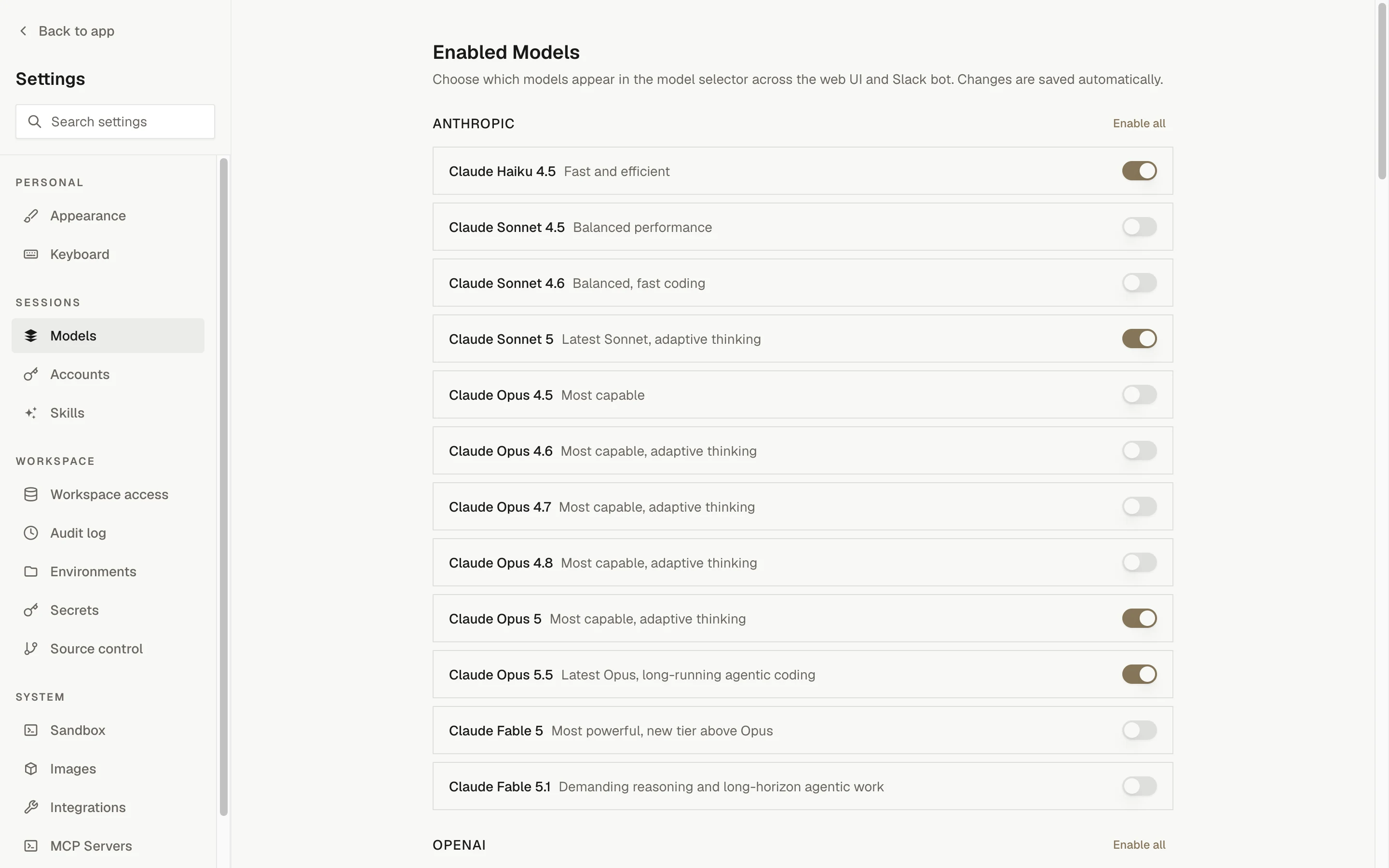
Enable models in Settings › Models
Settings › Models lists every model in the catalog, grouped by provider, under the heading Enabled Models. Toggle a model on or off, or use Enable all and Disable all on a group. Changes save automatically and apply to the model selector across the web app and the Slack bot. You cannot disable the last enabled model.
| Group | Enabled by default |
|---|---|
| Anthropic | Yes |
| OpenAI | Yes |
| OpenCode Zen | No |
| OpenCode Go | No |
| xAI / SuperGrok | No |
| Kimi Coding Plan | No |
| Z.AI Coding Plan | No |
| DeepSeek | No |
The deployment default model is Claude Sonnet 4.6 (anthropic/claude-sonnet-4-6). It is used when nothing else (a session, an integration setting, or an automation) picks a model.
Pick a model and effort in the composer
The composer shows one control that reads <harness>: <model> <effort>. Open it to see up to three rows:
| Row | What it does |
|---|---|
| Agent | Chooses the harness (OpenCode, Claude Agent, or Codex). Shown only when you create a session; the harness is fixed afterwards. See Agent harnesses. |
| Model | Lists the enabled models the chosen harness can run, grouped by provider, with each model's display name and one-line description. |
| Effort | Lists Default plus the efforts the model supports on the chosen harness (None, Low, Medium, High, XHigh, Max). Hidden for models without reasoning controls. |
Default effort means the model's own default from the table below. Choosing a specific effort applies it to the prompts you send.
You can change the model and effort for each follow-up; the harness cannot change. The list therefore only contains models the session's harness can run. If a message override names a model the harness cannot run, the prompt is rejected with an error such as Model "openai/gpt-5.5" cannot run on the Claude Agent harness. It is never silently replaced with another model.
Model catalog
Reasoning efforts and defaults below come from the shared model catalog. A model with no reasoning efforts has no Effort row in the composer. A default of "Not set" means no effort is sent until you pick one, so the provider's own default applies. An effort set earlier in the session, in a saved Slack preference or on a parent session carries over to a new model that supports that level.
Anthropic
Runs on OpenCode and Claude Agent. Credential: ANTHROPIC_API_KEY as a global secret, or on Claude Agent sessions a connected Claude account (see Provider accounts).
| Model ID | Display name | Reasoning efforts | Default effort |
|---|---|---|---|
anthropic/claude-haiku-4-5 | Claude Haiku 4.5 | high, max | max |
anthropic/claude-sonnet-4-5 | Claude Sonnet 4.5 | high, max | max |
anthropic/claude-sonnet-4-6 | Claude Sonnet 4.6 | low, medium, high, max | high |
anthropic/claude-sonnet-5 | Claude Sonnet 5 | low, medium, high, xhigh, max | high |
anthropic/claude-sonnet-5-5 | Claude Sonnet 5.5 | low, medium, high, xhigh, max | high |
anthropic/claude-opus-4-5 | Claude Opus 4.5 | high, max | max |
anthropic/claude-opus-4-6 | Claude Opus 4.6 | low, medium, high, max | high |
anthropic/claude-opus-4-7 | Claude Opus 4.7 | low, medium, high, xhigh, max | high |
anthropic/claude-opus-4-8 | Claude Opus 4.8 | low, medium, high, xhigh, max | high |
anthropic/claude-opus-5 | Claude Opus 5 | low, medium, high, xhigh, max | high |
anthropic/claude-opus-5-5 | Claude Opus 5.5 | low, medium, high, xhigh, max | high |
anthropic/claude-fable-5 | Claude Fable 5 | low, medium, high, xhigh, max | high |
anthropic/claude-fable-5-1 | Claude Fable 5.1 | low, medium, high, xhigh, max | high |
OpenAI
Runs on OpenCode, and every model except GPT 5.4 also runs on Codex. Credential: a connected ChatGPT account, or OPENAI_API_KEY in the session's secret scope when the session uses API-key mode.
| Model ID | Display name | Reasoning efforts | Default effort |
|---|---|---|---|
openai/gpt-5.4 | GPT 5.4 | none, low, medium, high, xhigh | Not set |
openai/gpt-5.5 | GPT 5.5 | none, low, medium, high, xhigh | Not set |
openai/gpt-5.6-sol | GPT 5.6 Sol | none, low, medium, high, xhigh | medium |
openai/gpt-5.6-terra | GPT 5.6 Terra | none, low, medium, high, xhigh | medium |
openai/gpt-5.6-luna | GPT 5.6 Luna | none, low, medium, high, xhigh, max | medium |
openai/gpt-6-astra | GPT-6 Astra | low, medium, high, xhigh, max | medium |
openai/gpt-6-sol | GPT-6 Sol | none, low, medium, high, xhigh, max | medium |
openai/gpt-6.1-sol | GPT-6.1 Sol | low, medium, high, xhigh, max | medium |
openai/gpt-6.1-terra | GPT-6.1 Terra | none, low, medium, high, xhigh, max | medium |
openai/gpt-6.2-astra | GPT-6.2 Astra | low, medium, high, xhigh, max | medium |
openai/gpt-6.2-sol | GPT-6.2 Sol | low, medium, high, xhigh, max | medium |
openai/gpt-6-luna | GPT-6 Luna | none, low, medium, high, xhigh, max | medium |
"Not set" means the composer shows Default and sends no effort unless you choose one.
On Codex, each model has its own effort list and default: never None, and Max on some models that do not offer it on OpenCode.
| Display name | Codex efforts | Codex default |
|---|---|---|
| GPT 5.4 | Not on Codex | N/A |
| GPT 5.5 | low, medium, high, xhigh | medium |
| GPT 5.6 Sol | low, medium, high, xhigh, max | low |
| GPT 5.6 Terra | low, medium, high, xhigh, max | medium |
| GPT 5.6 Luna | low, medium, high, xhigh, max | medium |
| GPT-6 Astra | low, medium, high, xhigh, max | low |
| GPT-6 Sol | low, medium, high, xhigh, max | medium |
| GPT-6.1 Sol | low, medium, high, xhigh, max | low |
| GPT-6.1 Terra | low, medium, high, xhigh, max | low |
| GPT-6.2 Astra | low, medium, high, xhigh, max | low |
| GPT-6.2 Sol | low, medium, high, xhigh, max | low |
| GPT-6 Luna | low, medium, high, xhigh, max | medium |
xAI / SuperGrok
Runs on OpenCode only. Opt-in group. Credential: a connected SuperGrok account, or XAI_API_KEY in API-key mode. Entitlement to a given Grok model is decided by xAI for the connected account.
| Model ID | Display name | Reasoning efforts | Default effort |
|---|---|---|---|
xai/grok-4.5 | Grok 4.5 | low, medium, high | high |
xai/grok-4.6 | Grok 4.6 | low, medium, high, xhigh | high |
xai/grok-4.7 | Grok 4.7 | low, medium, high, xhigh | high |
xai/grok-build-0.1 | Grok Build 0.1 | Not configurable | N/A |
OpenCode Zen
Runs on OpenCode only. Opt-in group. Credential: OPENCODE_API_KEY as a global or repository secret. Zen is billed per token.
| Model ID | Display name | Reasoning efforts | Default effort |
|---|---|---|---|
opencode/kimi-k2.5 | Kimi K2.5 | Not supported | N/A |
opencode/kimi-k2.6 | Kimi K2.6 | Not supported | N/A |
opencode/kimi-k3 | Kimi K3 | low, high, max | Not set |
opencode/minimax-m2.5 | MiniMax M2.5 | Not supported | N/A |
opencode/qwen3.7-max | Qwen3.7 Max | Not supported | N/A |
opencode/glm-5 | GLM 5 | Not supported | N/A |
opencode/glm-5.1 | GLM 5.1 | Not supported | N/A |
opencode/glm-5.2 | GLM 5.2 | high, max | Not set |
opencode/gemini-4-carbon | Gemini 4 Carbon | low, medium, high | high |
opencode/gemini-4-argon | Gemini 4 Argon | low, medium, high | high |
opencode/gemini-3.8-flash | Gemini 3.8 Flash | low, medium, high | high |
OpenCode Go
Runs on OpenCode only. Opt-in group. Credential: the same OPENCODE_API_KEY secret as Zen, but the key must carry an active OpenCode Go subscription. Go bills against the subscription's rolling allowance instead of per token, so a key without a Go subscription fails on opencode-go/* models while opencode/* models keep working.
Rolling allowance and unattended sessions
Go usage is capped on three rolling windows: 20% of the monthly allowance per 5 hours, 50% per week, and 100% per month. Allowances differ per model. An unattended session pinned to a Go model can exhaust its window and fail mid-run, so keep Go models off Slack, GitHub, Linear, and automation launches unless you accept that.
| Model ID | Display name | Reasoning efforts | Default effort |
|---|---|---|---|
opencode-go/grok-4.6 | Grok 4.6 | Not supported | N/A |
opencode-go/gpt-5.6-luna | GPT 5.6 Luna | none, low, medium, high, xhigh, max | Not set |
opencode-go/gemini-4-argon | Gemini 4 Argon | low, medium, high | high |
opencode-go/glm-5.3-flash | GLM 5.3 Flash | low, high, max | Not set |
opencode-go/glm-5.3 | GLM 5.3 | low, high, max | Not set |
opencode-go/glm-5.2 | GLM 5.2 | high, max | Not set |
opencode-go/glm-5.1 | GLM 5.1 | Not supported | N/A |
opencode-go/kimi-k3 | Kimi K3 | max | Not set |
opencode-go/kimi-k2.7-code | Kimi K2.7 Code | Not supported | N/A |
opencode-go/kimi-k2.6 | Kimi K2.6 | Not supported | N/A |
opencode-go/longcat-2.0 | LongCat 2.0 | Not supported | N/A |
opencode-go/deepseek-v4.1-flash | DeepSeek V4.1 Flash | low, high, max | Not set |
opencode-go/deepseek-v4-pro | DeepSeek V4 Pro | high, max | Not set |
opencode-go/deepseek-v4-flash | DeepSeek V4 Flash | Not supported | N/A |
opencode-go/deepseek-v4-flash-vision-exp | DeepSeek V4 Flash Vision Exp | Not supported | N/A |
opencode-go/mimo-v2.5 | MiMo V2.5 | Not supported | N/A |
opencode-go/mimo-v2.5-pro | MiMo V2.5 Pro | Not supported | N/A |
opencode-go/minimax-m3 | MiniMax M3 | Not supported | N/A |
opencode-go/minimax-m2.7 | MiniMax M2.7 | Not supported | N/A |
opencode-go/muse-spark-1.3-contributor | Muse Spark 1.3 Contributor | low, medium, high, xhigh | Not set |
opencode-go/muse-spark-1.2-contributor | Muse Spark 1.2 Contributor | low, medium, high, xhigh | Not set |
opencode-go/qwen3.8-max | Qwen3.8 Max | low, medium, xhigh | Not set |
opencode-go/qwen3.8-flash | Qwen3.8 Flash | low, medium, xhigh | Not set |
opencode-go/qwen3.7-max | Qwen3.7 Max | Not supported | N/A |
opencode-go/qwen3.7-plus | Qwen3.7 Plus | high, max | Not set |
opencode-go/qwen3.6-plus | Qwen3.6 Plus | Not supported | N/A |
opencode-go/hy4-preview | Hy4 Preview | none, high | Not set |
opencode-go/hy3 | Hy3 | none, low, high | Not set |
Go also publishes minimax-m2.5, but the pinned OpenCode release does not resolve it on the Go gateway, so it is left out of the catalog. Use opencode/minimax-m2.5 on Zen instead.
Kimi Coding Plan
Runs on OpenCode only. Opt-in group. Credential: a Kimi Code membership API key in KIMI_API_KEY as a global or repository secret. Requests use Kimi's overseas coding endpoint and the membership plan's allowance, separate from Kimi models billed through OpenCode Go. Model and context-window access depend on the plan: the Highspeed models need Pro or above (Allegretto or above on legacy plans), and a plan without access returns 403. See Kimi's model requirements.
| Model ID | Display name | Reasoning efforts | Default effort |
|---|---|---|---|
kimi-code-plan-global/k3.1-pro | Kimi K3.1 Pro | Not supported | N/A |
kimi-code-plan-global/k3.1-pro-highspeed | Kimi K3.1 Pro Highspeed | Not supported | N/A |
kimi-code-plan-global/k3 | Kimi K3 | Not supported | N/A |
kimi-code-plan-global/k3-256k | Kimi K3 256K | Not supported | N/A |
kimi-code-plan-global/kimi-for-coding | Kimi for Coding | Not supported | N/A |
kimi-code-plan-global/kimi-for-coding-highspeed | Kimi for Coding Highspeed | Not supported | N/A |
Z.AI Coding Plan
Runs on OpenCode only. Opt-in group. Credential: ZHIPU_API_KEY as a global or repository secret.
| Model ID | Display name | Reasoning efforts | Default effort |
|---|---|---|---|
zai-coding-plan/glm-5.2 | GLM 5.2 | Not supported | N/A |
zai-coding-plan/glm-5.3 | GLM 5.3 | Not supported | N/A |
DeepSeek
Runs on OpenCode only. Opt-in group. Credential: DEEPSEEK_API_KEY as a global or repository secret.
| Model ID | Display name | Reasoning efforts | Default effort |
|---|---|---|---|
deepseek/deepseek-v4-flash | DeepSeek V4 Flash | Not supported | N/A |
deepseek/deepseek-v4-pro | DeepSeek V4 Pro | Not supported | N/A |
The same model behind several gateways
Some models appear more than once because they are reachable through more than one provider, each billed differently. opencode-go/grok-4.6 and xai/grok-4.6 are the same Grok model behind two gateways. opencode-go/glm-5.2, opencode/glm-5.2, and zai-coding-plan/glm-5.2 are the same GLM model behind three. opencode/gemini-4-argon and opencode-go/gemini-4-argon are the same Gemini model on Zen and Go: one OPENCODE_API_KEY serves both, billed per token on Zen and against the subscription allowance on Go. Pick the entry whose billing you want.
Defaults for integrations and automations
Automations run on the harness chosen in the automation editor. GitHub, Linear, and Slack sessions run on the Agent harness chosen in each integration's settings (OpenCode by default). GitHub and Linear also accept a harness per repository, and Slack users can pick their own harness in the app's Home tab. All three preserve the selected harness: if it cannot run the resolved model, the bot replies with a compatibility explanation and creates no session instead of switching to OpenCode. Each surface picks its model from these settings:
| Surface | Where the default lives |
|---|---|
| GitHub | Settings › Integrations › GitHub: Default model and Default reasoning effort, plus per-repository Repository Overrides. Falls back to the deployment default model. An @mention can start with !model and !reasoning flags to override them for the session it starts. |
| Linear | Settings › Integrations › Linear: Default model and effort and Repository Overrides. A model:* issue label wins when Allow model labels is on, then a Linear user preference (when allowed), then the repository override or global default, then the deployment default. |
| Slack | Settings › Integrations › Slack: Default model. A user's Model and Reasoning effort in the app's Home tab win over it, and !model and !reasoning flags win over both for the session they start. Uses the deployment default when no model is set. Claude Agent and Codex require a Slack Default model. |
| Automations | The automation editor picks a model and effort per automation. The list is limited to enabled models the automation's harness can run. |
All of these selectors show only models enabled in Settings › Models. Reasoning values must be ones the selected model supports.
For Slack, a disabled effective model refuses a new session rather than selecting another model. Administrators can disable a saved default; update it, re-enable it, or use an enabled, harness-compatible App Home choice or leading !model override. See Slack model defaults.
For GitHub and Linear, explicitly selecting a restricted harness such as Claude Agent requires a compatible default model at the same settings level (global or repository), not an inherited model. Omitted repository harness and model fields inherit individually. Save validation checks each explicit level, not the merged global/repository pair; cross-level mismatches are refused at launch.
For a refused GitHub launch, retry a mention with a compatible !model, update the default model, or change the integration harness. For Linear, choose a compatible model:* label, user preference, or default model (subject to the label and preference override settings), or change the integration harness, then delegate again. See GitHub and Linear.
@OpenInspect !model anthropic/claude-sonnet-4-6 !reasoning max investigate the flaky test